
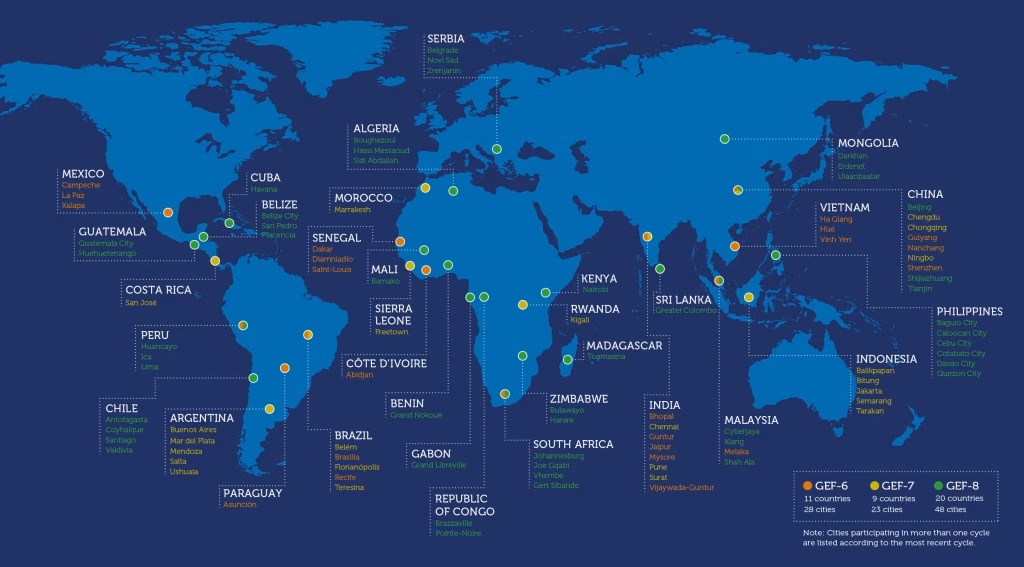
Map of GEF Sustainable Cities Program countries and cities. Image credit: GEF
The World Bank and the Global Environment Facility (GEF) have launched the next phase of the Sustainable Cities Integrated Program, reinforcing cities as strategic hubs for social investment, climate action, and inclusive economic growth.
Announced in Rio de Janeiro ahead of COP30, the new phase will extend targeted support to 40 additional cities across 20 countries, backed by $170 million in new GEF grant financing and structured pathways to unlock large-scale co-financing.
The expansion responds to mounting urban pressures, including climate risks and environmental degradation, as well as inequality and service delivery gaps, by investing directly in systems that improve people’s daily lives.
“Cities are at the forefront of sustainability, leadership, and innovation,” said GEF CEO Carlos Manuel Rodríguez, opening the launch event.
“Complex environmental challenges demand integrated, systematic solutions and cities are uniquely positioned to deliver them.”
Since its inception in 2016, the Sustainable Cities Integrated Program has deployed $480 million in GEF grants, reaching more than 90 cities in 34 countries.
These investments have catalyzed nearly $6 billion in co-financing, supporting projects that combine environmental protection with social and economic returns, including clean water systems, resilient infrastructure, sustainable transport, and nature-based urban solutions.
The World Bank will implement the new phase through the Global Platform for Sustainable Cities (GPSC).
At the core of the approach is a dual-track model that pairs grant financing with global knowledge, peer learning, and technical tools.
This model helps cities move from ambition to implementation, ensuring that sustainability plans translate into fundable, scalable projects.
“By embedding knowledge generation and peer learning into every stage of project development, GPSC helps cities translate ambition into tangible action,” said Ming Zhang, the World Bank’s Global Director for Urban, Resilience, and Land.
The launch took place during the GPSC Mayors’ Roundtable and Urban Nature Forum, co-hosted by the International Finance Corporation (IFC) on the sidelines of the COP30 Local Leaders’ Forum in Rio from November 3–5, 2025.
Mayors, city officials, multilateral development banks, and technical partners engaged in dialogue on strengthening project bankability, improving municipal finance frameworks, and de-risking investments to attract sustainable capital.
City examples highlighted how environmental investment delivers direct social benefits.
Belize City is strengthening its blue economy by protecting coastal ecosystems while improving drainage, sanitation, and climate resilience for communities dependent on marine resources.
Brazzaville, in the Republic of Congo, is addressing flooding, erosion, and land degradation through greener neighborhood upgrades and nature-based solutions that protect vulnerable populations.
Ulaanbaatar, Mongolia, is tackling air pollution, flooding, and waste challenges while expanding green public spaces and clean energy solutions, particularly in underserved ger districts.
Beyond participating cities, GPSC “Lighthouse Cities” shared lessons on mobilizing finance at scale. Bogotá, Colombia, for example, showcased its $600 million international sustainability bond, which finances rail, bus, and aerial cable transport systems that expand access to jobs and essential services.
Representatives from major development finance institutions, including the World Bank, IFC, IDB, EBRD, and the Development Bank of Southern Africa, emphasized that strengthening urban governance, planning, and creditworthiness is critical to unlocking long-term social investment.
Looking ahead, the new phase will coordinate learning across three priority areas: nature-positive and resilient urban development, decarbonizing the built environment, and the circular economy, supported by cross-cutting themes such as land-use planning, inclusive policies, gender equity, and sustainable financing.
As cities absorb the majority of future population growth, the Sustainable Cities Integrated Program positions urban sustainability as a high-impact social investment, one that delivers environmental protection, economic opportunity, and improved quality of life at scale.
Help us tell more untold stories of African Philanthropy!


